
UP 2026 Trade Show: Why Uttar Pradesh and Agra Lead Footwear Manufacturing

Uttar Pradesh is no longer just a large consumer market. It is becoming one of India’s most watched manufacturing stories, backed by scale, policy, infrastructure, MSMEs, exports, and a district-led production model through One District One Product Uttar Pradesh.
The UP International Trade Show 2026 will arrive at a time when global buyers are looking for reliable production partners beyond traditional supply chains. For footwear businesses, that search leads naturally to Agra, one of India’s most established footwear clusters and the home of MakeMyShoe’s custom footwear, OEM, ODM, private-label, branding, and production capabilities.

What makes the UP International Trade Show 2026 important for manufacturing?
Trade shows matter when they reflect a larger economic shift. The UP International Trade Show 2026 is expected to do exactly that by bringing together exporters, manufacturers, buyers, investors, MSMEs, and district-level producers under one state-led growth story.
Uttar Pradesh has built that story around three clear pillars:
Large-scale industrial development
Stronger logistics and infrastructure
District-specific manufacturing through ODOP Uttar Pradesh
The state’s economic base is already large. Uttar Pradesh is India’s most populous state and one of its biggest state economies. The Uttar Pradesh Budget and official state documents have placed the state’s economy at roughly the ₹25 lakh crore scale in recent estimates, making it central to India’s goal of expanding domestic manufacturing.
The state is also positioning itself toward a $1 trillion economy target, supported by Invest UP, sector policies, industrial corridors, expressways, logistics parks, and export promotion programs.
A few official data points show why the discussion around Uttar Pradesh economic growth has moved from ambition to execution.
Indicator | Recent official position | Source type |
State economy | Around the ₹25 lakh crore GSDP scale in recent budget estimates | Uttar Pradesh Budget and state economic documents |
MSME base | Around 9.6 million MSMEs, among the largest in India | Uttar Pradesh Government and MSME policy references |
ODOP coverage | All 75 districts covered under district-specific products | ODOP official portal |
Investment proposals | More than ₹35 lakh crore in proposals reported at the 2023 Global Investors Summit | Invest UP and Uttar Pradesh Government |
Project grounding | Around ₹10 lakh crore worth of projects reported during Ground Breaking Ceremony 4.0 in 2024 | Uttar Pradesh Government |
Merchandise exports | Exports crossed the ₹1.7 lakh crore range in recent official export reporting | UP Export Promotion Bureau and government export data |
These numbers matter because they point to depth, not just size. A state with large MSME participation, rising exports, sector clusters, and improving infrastructure can support long-term industrial planning. That is why many companies now view UP as a serious manufacturing partner India can offer to both domestic and international buyers.
Why choose Uttar Pradesh as your manufacturing partner?
The strongest case for Uttar Pradesh is that it combines production scale with policy direction. For footwear, textiles, food processing, electronics, engineering goods, defense manufacturing, and handicrafts, the state is building an ecosystem where district strengths are tied to export and investment strategy.
This is what makes the state a rising Uttar Pradesh manufacturing hub.
UP has a large industrial and MSME base
MSMEs form the backbone of production in Uttar Pradesh. Official state references place the MSME base at around 9.6 million units. This matters because MSMEs support vendor development, component supply, job work, finishing, packaging, and district-level specialization.
In footwear, that base supports activities such as:
Pattern development
Upper stitching
Sole sourcing
Lining and material preparation
Finishing
Packaging
Small-batch customization
Export-ready production support
For buyers, a mature MSME network reduces dependency on a single factory layer. It creates a wider support system around manufacturing.
UP has built hard infrastructure at scale
Infrastructure has changed the manufacturing equation in Uttar Pradesh. The state has developed and expanded major expressways, including the Yamuna Expressway, Agra-Lucknow Expressway, Purvanchal Expressway, and Bundelkhand Expressway. The Ganga Expressway, planned at about 594 km, is one of the state’s major logistics projects.
These corridors connect production centers with consumption markets, freight routes, airports, and industrial nodes. For manufacturing in Uttar Pradesh, this means faster movement of raw material, semi-finished goods, and finished products.
The state also benefits from:
Eastern Dedicated Freight Corridor connectivity
Inland waterway potential through National Waterway-1
Multi-modal logistics planning
Expanding airport capacity
Industrial townships and sector-specific parks
The Uttar Pradesh Defense Industrial Corridor
For exporters, logistics is not a side issue. It affects lead times, working capital, reliability, and buyer confidence.

UP has a clear investment pipeline
Invest UP and the Uttar Pradesh Government have reported more than ₹35 lakh crore in investment proposals from the 2023 Global Investors Summit. The state also reported project grounding at the ₹10 lakh crore scale during Ground Breaking Ceremony 4.0 in 2024.
Investment proposals are not the same as completed factories, but grounding activity shows movement from announcement to implementation. That is important for businesses evaluating Uttar Pradesh investment opportunities over a 5-year to 10-year horizon.
For footwear companies, this wider investment climate improves the supporting ecosystem. Better roads, warehousing, power, logistics, and industrial services help factories compete on delivery and consistency.
UP is turning district identity into export strategy
The ODOP model gives Uttar Pradesh a distinctive advantage. Instead of treating every district the same, ODOP identifies products linked to local skill, material history, and production expertise.
That approach supports:
Skill preservation
Cluster-based production
District-level exports
MSME formalization
Product development
Buyer discovery
For Agra, the ODOP association with leather products aligns directly with its footwear legacy. That makes Agra more than a manufacturing location. It makes it a district-level example of how ODOP can connect local skill with global demand.
Why is Agra important to India’s footwear manufacturing ecosystem?
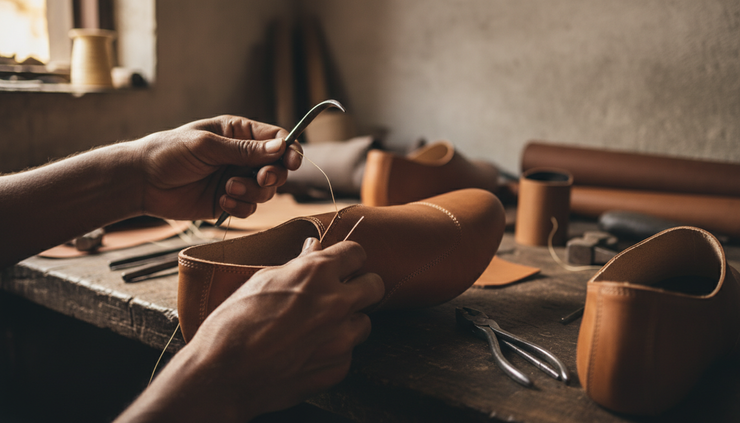
Agra is one of India’s most recognized footwear manufacturing centers. Its strength comes from years of accumulated skill across leather work, shoe construction, pattern making, stitching, lasting, finishing, and export-oriented production.
Official ODOP listings identify Agra with leather products. That matters because Agra’s footwear cluster fits the exact purpose of One District One Product Uttar Pradesh: take a historically strong local industry and support it with market access, production identity, and growth opportunities.
Agra brings together skill and supply chains
Footwear is not a single-step product. A quality shoe needs design translation, material selection, cutting accuracy, upper-making, sole attachment, finishing, branding application, packaging, and quality checks.
Agra’s ecosystem supports these stages through a dense network of skilled workers, component vendors, small units, larger manufacturers, and finishing specialists. This is why Agra footwear manufacturing remains strategically important for domestic and export buyers.
For brands and businesses, the local advantage is practical. Agra can support small custom runs, mid-sized private-label batches, and larger production programs because the surrounding ecosystem already understands footwear.
Footwear aligns naturally with export growth
Uttar Pradesh exports include categories such as leather products, engineering goods, carpets, textiles, agricultural products, and handicrafts. The state’s export value crossing the ₹1.7 lakh crore range in recent official reporting shows that UP is not only producing for local consumption. It is increasingly integrated with national and global trade.
Footwear manufacturing in Uttar Pradesh benefits from this export mindset. Buyers want factories that understand quality standards, packaging, timelines, documentation, and repeat production. Agra’s long exposure to footwear trade makes it a natural fit.
MakeMyShoe adds modern production capability to Agra’s cluster strength
MakeMyShoe builds on Agra’s footwear foundation with a production model designed for modern businesses. The company supports:
Custom footwear manufacturing
OEM production
ODM development
Private-label footwear manufacturing
Branding and packaging support
Material and style development
Sampling and production coordination
Scalable manufacturing for different business needs
This is important because footwear buyers increasingly need flexibility. They may need custom sneakers, leather shoes, boots, sandals, formal footwear, or lifestyle collections. They may already have designs and need OEM execution. Or they may need ODM support from concept to finished product.
MakeMyShoe’s value is the ability to connect these needs with Agra’s manufacturing base and Uttar Pradesh’s larger industrial momentum.
How does ODOP connect Agra, exports, and private-label footwear?
ODOP works best when a district product has three strengths: skill, commercial demand, and room to scale. Agra’s leather and footwear ecosystem has all three.
The ODOP framework gives districts like Agra a stronger identity in trade promotion. It also supports the broader goal of turning local production into export-ready manufacturing. For footwear, the benefits are clear.
It helps buyers identify trusted clusters
Global buyers often search by capability, not geography. ODOP makes district strengths easier to understand. When Agra is associated with leather products and footwear capability, buyers can quickly connect the district with relevant production expertise.
That improves discovery for manufacturers and confidence for buyers.
It supports MSME participation
Footwear production depends heavily on MSMEs. ODOP helps smaller units become part of a more visible supply chain. With better access to promotion, training, finance, packaging awareness, and market linkages, MSMEs can improve quality and reliability.
This strengthens Uttar Pradesh manufacturing at the ground level.
It fits private-label and custom production
Private-label footwear requires more than mass production. It needs design privacy, consistent quality, sample discipline, finishing control, packaging choices, and repeatability.
MakeMyShoe’s model fits this space. It can help businesses create footwear lines without building their own factory from day one. The work can include design interpretation, product development, construction planning, material selection, branding details, and final production.
This is where Agra’s expertise and MakeMyShoe’s production capabilities meet the future of footwear manufacturing.
How is Uttar Pradesh transforming after 2026?
The real question is not only what UP can show in 2026. It is what the UP economy 2026 can become after the trade show momentum moves into factories, export orders, logistics assets, and district-level production.
Uttar Pradesh’s future as a global manufacturing hub will depend on execution across five areas.
Faster logistics will shape buyer confidence
As expressways, freight corridors, airports, and warehousing networks mature, buyers will judge UP not only by production cost but by delivery reliability. Better logistics can reduce delays, improve inventory planning, and support export commitments.
For footwear, this can affect everything from raw material movement to finished-goods dispatch.
Industrial development will deepen supplier networks
UP industrial development is moving through industrial corridors, sector policies, and investment promotion. If these projects continue to convert into operating units, manufacturers will gain better access to machinery services, packaging suppliers, testing support, trained labor, and logistics partners.
That will make the state more competitive for long-term manufacturing contracts.
ODOP can move from identity to premium value
ODOP has already given each district a product identity. The next opportunity is value addition. For Agra, that means moving beyond volume production toward premium footwear, design-led collections, better finishing, responsible sourcing, and export-ready quality systems.
This is where MakeMyShoe sees a strong fit. Custom footwear and private-label manufacturing need district skill, but they also need modern production management.
UP can become a stronger export platform
Uttar Pradesh exports already show depth across multiple sectors. The next phase will depend on how well the state supports quality compliance, faster clearances, packaging standards, product development, and buyer access through platforms like the UP International Trade Show 2026.
For footwear, export growth will favor manufacturers that can combine craft, cost discipline, quality control, and flexible volumes.
Agra can lead the footwear chapter of UP’s growth story
Agra’s footwear ecosystem has the local knowledge. Uttar Pradesh has the policy and infrastructure direction. MakeMyShoe connects both to business needs through OEM, ODM, private-label, branding, and custom production.
That combination makes Agra a serious answer to a growing global question: where can footwear businesses find skilled, scalable, and reliable manufacturing partners in India?

What should businesses take away from UP’s manufacturing rise?
Uttar Pradesh is building one of India’s most important manufacturing stories through scale, MSMEs, infrastructure, investment, exports, and ODOP-led district specialization. Agra gives that story a footwear center with proven skill and commercial depth.
For businesses evaluating Uttar Pradesh manufacturing hub India, the case is strong:
The state economy has reached major national scale.
Official investment pipelines show serious industrial intent.
MSMEs create depth across supply chains.
Expressways and freight corridors improve movement.
ODOP connects district identity with export potential.
Agra offers one of India’s strongest footwear ecosystems.
MakeMyShoe brings this opportunity into practical production. From custom footwear and private-label collections to OEM and ODM manufacturing, it helps businesses convert ideas into finished footwear through Agra’s skilled ecosystem and Uttar Pradesh’s rising industrial base.
The vision after 2026 is clear: MakeMyShoe and Uttar Pradesh can stand together as partners for the next generation of Indian and global footwear manufacturing, where Agra’s craft, UP’s infrastructure, and modern production capability create footwear built for the world.


