
What Is MOQ in Footwear Manufacturing and Why Does It Matter for Startups
- Aditya Agarwal
- 16 hours ago
- 9 min read

<!-- Meta Title: MOQ in Footwear Manufacturing Explained -->
<!-- Meta Description: Understand MOQ in shoe manufacturing, typical MOQ considerations in India, and why low-MOQ manufacturers matter for footwear startups. -->
MOQ in footwear manufacturing means the minimum number of pairs a factory agrees to produce in one order. If a manufacturer says the MOQ is 100 pairs, the brand must order at least 100 pairs to start production. The answer to what is MOQ in footwear manufacturing is simple, but its impact is big. MOQ affects pricing, inventory, sampling, cash flow, design planning, and how quickly a new footwear brand can test the market.
For startups, D2C brands, and new e-commerce shoe businesses, MOQ can decide whether a product idea feels practical or too risky. Ordering too many pairs before knowing customer demand can block capital. Ordering too few may raise the cost per pair. The right footwear manufacturing MOQ finds a balance between factory efficiency and startup flexibility.

What is MOQ in footwear manufacturing?
MOQ stands for Minimum Order Quantity. In shoe production, it is the minimum order for shoes that a manufacturer needs to accept for bulk manufacturing.
MOQ may apply to:
One shoe design
One colour
One size range
One material combination
One sole type
One branded packaging requirement
For example, if a factory offers a custom sneaker with an MOQ of 100 pairs per colour, a brand wanting black and white versions may need to order 100 pairs in black and 100 pairs in white.
This is why startup founders should ask a precise question. Instead of only asking, “What is your MOQ?”, ask:
Is the MOQ per design or per colour?
Does size assortment count within the MOQ?
Is sampling included?
Does branding change the MOQ?
Can I reorder in larger quantities later?
Are packaging and labels included in the same MOQ?
A low number may look attractive at first, but the details matter.
Why do footwear manufacturers have MOQs?
Footwear factories have MOQs because shoe production involves setup, sourcing, labour planning, pattern development, material cutting, sole attachment, finishing, quality checks, and packing. Even a small batch takes time and resources.
A manufacturer usually needs MOQ to cover the cost of:
Creating or adjusting patterns
Setting up cutting dies, moulds, or templates
Sourcing uppers, linings, soles, laces, threads, eyelets, insoles, and packaging
Allocating workers and machines
Managing wastage during cutting and trial production
Checking fit, finish, and size consistency
Packing and dispatching finished shoes
Footwear is not like printing a simple T-shirt. A shoe has many parts, and each part must fit together correctly. Even a basic casual shoe may involve the upper, lining, insole, outsole, adhesive, stitching, reinforcement, branding, lace, packaging, and size labels.
That is why minimum order quantity shoes are connected to the factory’s real production cost, not just the number of pairs ordered.

What is a typical MOQ for custom footwear in India?
There is no universal MOQ in India. The MOQ varies by manufacturer, product category, materials, colours, customization level, branding, packaging, and production requirements.
A custom footwear MOQ for simple styles may be lower than a highly technical shoe that needs special soles, moulds, multiple materials, or complex construction. A private label footwear manufacturer may also offer different MOQ options depending on whether the brand uses existing designs or develops a fully custom product.
Here is a simple way to understand the difference.
Manufacturing option | Typical MOQ behaviour | Best suited for |
Ready design with minor branding | Usually lower because the base pattern already exists | New brands testing their first product |
Private label footwear | Moderate, depending on branding, colours, and packaging | D2C brands building a branded collection |
Custom upper on an existing sole | Moderate, because some development is needed | Startups testing a unique look |
Fully custom shoe development | Usually higher because patterns, materials, and trials are needed | Brands with clearer demand or funding |
Special moulded sole or technical product | Often higher due to tooling and component setup | Performance, safety, or niche footwear brands |
A low MOQ shoe manufacturer India startups work with may offer small batch footwear manufacturing for selected categories, but the exact number still depends on the design brief.
For example:
A simple slip-on using available materials may support a lower MOQ.
A sneaker with a custom outsole, three colours, special lining, and branded box may need a higher MOQ.
A sandal using existing sole units may be easier to produce in smaller batches than a new moulded sports shoe.
Why do factories have high MOQs?
Factories may set high MOQs when the product needs special sourcing, moulds, machine setup, or a longer production line. This is common in custom shoe manufacturing India projects where the brand wants a distinct look, material, or construction.
High MOQs often come from:
Material supplier requirements Some suppliers sell leather, fabric, soles, or trims only in minimum quantities.
Tooling and mould costs Custom soles, heels, and footbeds may need moulds. These costs must be spread across enough pairs.
Production line efficiency A factory loses time when it frequently changes designs, colours, and materials.
Wastage allowance Cutting and trial runs create waste, especially in leather and patterned materials.
Skilled labour planning Stitching, lasting, and finishing require trained workers. Small orders still need supervision and quality checks.
Packaging setup Branded boxes, labels, tags, and inserts may have their own supplier MOQs.
Economies of scale also matter. A larger order can reduce the cost per pair because setup and sourcing costs are spread across more units. A smaller order usually gives more flexibility, but the cost per pair may be higher.
Is low MOQ better for startups?
Low MOQ can be better for startups because it reduces inventory risk and allows real market testing. It is useful when a brand wants to validate a design, launch with limited capital, or test different styles before scaling.
Low MOQ footwear manufacturing can help startups:
Test product-market fit before committing to a large batch
Launch limited drops for an e-commerce store
Learn which sizes, colours, and styles sell faster
Reduce unsold stock
Improve the next production run based on customer feedback
Preserve cash for marketing, fulfilment, and customer service
Start with custom branding without ordering a large inventory
For example, a new D2C sneaker brand may want to launch two designs in neutral colours. A high MOQ may force the brand to invest in more stock than it can sell quickly. A low MOQ footwear manufacturer can allow the brand to test one or two styles first, study demand, and then reorder the stronger design.
Low MOQ is not always the cheapest option per pair. It often costs more per pair than bulk production. But for a startup, paying slightly more per pair may be better than locking money into hundreds or thousands of unsold shoes.
Low MOQ is mainly about reducing early risk. Higher MOQ is mainly about reducing per-pair cost once demand is clearer.
MakeMyShoe works with footwear startups, D2C brands, and e-commerce sellers as an Indian OEM, ODM, and private-label footwear manufacturer. This can support a practical path from sampling to small batch production and later bulk manufacturing, based on the product and brand requirements.
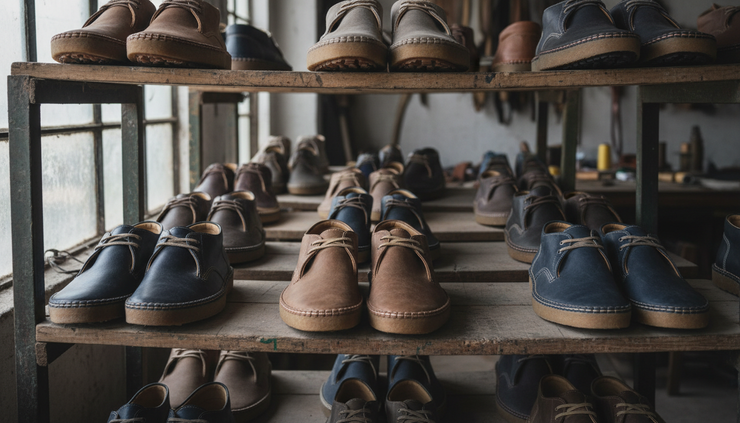
Does MOQ apply per design or colour?
Yes, MOQ often applies per design, per colour, or both. This is one of the most important points to confirm before placing an order.
A manufacturer may say:
MOQ is 100 pairs per design
MOQ is 100 pairs per colour
MOQ is 300 pairs total, with approved colour splits
MOQ changes if the material or sole changes
MOQ changes if packaging is customized
Here is a practical example.
A startup wants one loafer design in black, tan, and navy. The manufacturer offers an MOQ of 100 pairs per colour. The actual order becomes 300 pairs, not 100 pairs.
Another example:
A brand wants one sneaker design in white, but with two lace options. If the shoe construction and colour remain the same, the factory may treat it as one production run. If the upper material or outsole changes, it may become a separate MOQ.
What is the difference between a sample and MOQ?
A sample is a prototype or trial pair made before bulk production. MOQ is the minimum bulk order after the sample is approved.
Sampling helps confirm:
Shape and fit
Material feel
Sole comfort
Stitching quality
Branding placement
Colour accuracy
Packaging direction
A sample does not usually mean the factory can produce only one or two pairs for sale. Sample making is a development step, while MOQ is a production requirement.
A startup should treat sampling as part of product development, not as a substitute for manufacturing. After the sample is approved, the confirmed shoe manufacturing MOQ applies.
Can I increase my order quantity later?
Yes, most manufacturers can increase production later if materials, soles, patterns, and capacity are available. This is how many startups scale responsibly.
A practical scaling path can look like this:
Develop the concept
Share sketches, references, materials, target price, and customer profile.
Make samples
Test fit, finish, comfort, and branding.
Start with a low MOQ
Launch a smaller production run to test demand.
Track sales data
Study which sizes, colours, and designs move fastest.
Improve the next batch
Adjust fit, materials, packaging, or colour mix based on feedback.
Reorder stronger styles
Increase quantity only where demand is proven.
Move to larger production
Use economies of scale to improve cost per pair when volumes grow.
This approach keeps the brand flexible. It also gives the manufacturer better clarity on what to prepare for future production.
A shoe manufacturer for startups should be able to discuss both early-stage production and future scaling. The best fit is not only a factory that says yes to a low MOQ. It is a manufacturer that can support product development, branding, packaging, reorders, and larger production when the brand is ready.

How should startups discuss MOQ with a footwear manufacturer?
A clear brief helps the manufacturer give a realistic MOQ and cost estimate. Vague requests like “I want sneakers” usually lead to unclear answers.
Before contacting a custom footwear manufacturer India startups should prepare:
Product category Sneaker, loafer, sandal, boot, slipper, formal shoe, or kids’ footwear
Target customer Everyday wear, premium fashion, uniform use, gifting, or e-commerce drop
Quantity expectation Sample requirement, first order size, and possible reorder plan
Design references Photos, sketches, mood boards, or physical samples
Material preference Leather, synthetic, canvas, knit, EVA, rubber, or mixed materials
Branding needs Logo on insole, outsole, upper, tongue, box, tag, or dust bag
Colour plan Number of colourways and expected quantity per colour
Size range Men’s, women’s, kids’, or unisex sizing
Packaging needs Plain box, branded box, labels, inserts, or e-commerce-ready packing
This helps the manufacturer explain the realistic footwear manufacturing MOQ, sampling cost, production timeline, and cost per pair.
How does low MOQ affect cost per pair?
Low MOQ usually increases the cost per pair because setup, development, sourcing, and labour are spread across fewer units. This does not mean low MOQ is bad. It means the brand must understand the trade-off.
For a startup, the decision is often between:
Low MOQ | High MOQ |
Lower inventory risk | Lower cost per pair |
Easier product testing | Better economies of scale |
More flexibility in designs | More stock to manage |
Useful for first launches | Useful after demand is proven |
Higher per-pair cost | Higher upfront investment |
A first-time brand may accept a higher per-pair cost to avoid excess stock. Once a design sells well, the brand can increase order quantity and work toward better pricing.
FAQ
What does MOQ mean in footwear manufacturing?
MOQ means Minimum Order Quantity. It is the minimum number of pairs a footwear manufacturer will produce in one bulk order.
Is there a standard MOQ for footwear manufacturing in India?
No. There is no universal MOQ in India. It varies by manufacturer, product type, materials, customization, colours, packaging, and production needs.
Does MOQ apply to each shoe design?
Often, yes. Many manufacturers apply MOQ per design, especially when each design needs separate patterns, materials, or production setup.
Does MOQ apply to each colour?
In many cases, yes. If a factory says MOQ is per colour, ordering three colours can multiply the total quantity required.
Can I order only samples before meeting MOQ?
Yes, samples are usually possible before bulk production. But samples are for approval and testing. They do not replace the bulk MOQ.
Why is low MOQ useful for a footwear startup?
Low MOQ helps startups reduce inventory risk, test demand, launch limited drops, collect customer feedback, and scale with more confidence.
Is low MOQ always cheaper?
No. Low MOQ often has a higher cost per pair because setup and sourcing costs are spread across fewer pairs.
Can I use custom branding with low MOQ?
Sometimes. Logo placement, branded insoles, labels, boxes, and packaging may be possible, but the MOQ can change based on the customization.
Can I increase production after my first batch sells?
Yes. Startups can usually increase production later if the materials, components, patterns, and factory capacity are available.
What should I ask a manufacturer before confirming MOQ?
Ask whether MOQ is per design or colour, what is included in sampling, how branding affects MOQ, what the cost per pair is, and whether reorders can be scaled.
How can MakeMyShoe help with MOQ planning?
MakeMyShoe supports footwear manufacturing in India for startups, D2C brands, e-commerce sellers, and growing labels that need a practical route from idea to production.
As an Indian OEM, ODM, and private-label footwear manufacturer, MakeMyShoe can help with:
Custom footwear development
Private label footwear production
Sampling and design refinement
Brand logo placement
Packaging support
Small batch and scalable production
Reorder planning as demand grows
MOQ should not be treated as a barrier. It should be treated as a planning tool. The right manufacturer will explain what is possible, what affects quantity, and how to move from a first test batch to larger production.
If you are building a footwear brand and want to discuss design, MOQ, customization, branding, packaging, or production requirements, connect with MakeMyShoe to plan your footwear project.

