
Agra Footwear Manufacturing Hub Why India’s Shoe Capital Is a Smart Sourcing Choice

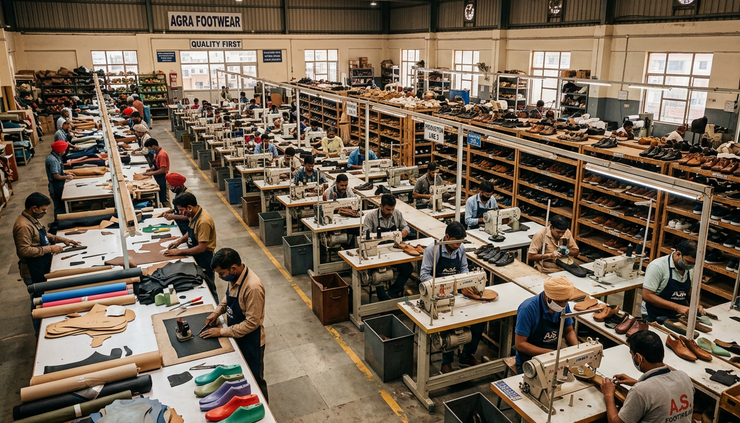
Agra is known for footwear manufacturing because it has a long shoemaking history, a large skilled workforce, strong leather and non-leather production capability, and a dense supplier network for soles, uppers, trims, packaging, finishing, and export documentation. For brands, that means faster sampling, practical customization, and access to manufacturers who understand both traditional craftsmanship and modern production needs.
That is why Agra remains one of India’s most credible footwear sourcing destinations, especially for startups, D2C labels, retailers, e-commerce sellers, and international buyers looking for dependable manufacturing without treating footwear as a purely transactional product.
Why is Agra known for footwear manufacturing?
Agra’s footwear reputation did not appear overnight. The city has generations of artisans, workshops, component suppliers, traders, and manufacturers who have built their livelihoods around shoes. This depth matters because footwear is a detail-heavy product. Fit, pattern, sole bonding, upper finishing, lining, comfort, durability, and packaging all affect customer satisfaction.
A buyer sourcing from a new manufacturing location often faces three risks:
Samples look good, but bulk production varies.
The factory can make one category, but struggles with new materials.
Timelines slip because local suppliers are limited.
Agra reduces many of these risks because its footwear ecosystem is concentrated. A manufacturer can often source uppers, soles, adhesives, insoles, trims, cartons, labels, and finishing services through established local networks. That does not remove the need for due diligence, but it gives buyers a stronger base to work from.
The Agra footwear manufacturing hub is also practical for mixed product development. A D2C brand may start with leather loafers, then add casual sneakers or sandals. A retailer may need formal shoes, women’s flats, school shoes, and private-label packaging. Agra has the ecosystem to support these variations.
Is Agra the shoe manufacturing capital of India?
Many people call Agra India’s shoe capital because of its long association with footwear, especially leather shoes. The phrase is widely used in trade and industry conversations. It reflects the city’s identity, skills, and manufacturing concentration rather than a single official ranking.
India’s footwear industry is spread across several clusters. Chennai, Kanpur, Kolkata, Mumbai, Delhi NCR, and parts of Punjab also contribute to the sector. Agra stands out because footwear manufacturing is deeply embedded in the city’s economy and workforce.
Government and industry bodies such as the Council for Leather Exports and India Brand Equity Foundation regularly discuss India’s leather and footwear sector as an important manufacturing and export category. Agra is commonly recognised as one of the country’s key footwear clusters, especially for leather footwear and related manufacturing skills.
The more useful question for a buyer is not whether Agra is number one by a specific metric. The better question is this: Can Agra support the type of footwear, quality level, order size, and delivery timeline your brand needs?
In many cases, the answer is yes.
What types of footwear are manufactured in Agra?
Agra is best known for leather footwear, but the city’s capabilities now extend beyond traditional leather shoes. Many manufacturers work across leather, synthetic, textile, EVA, rubber, PU, and other modern materials, depending on product category and buyer specifications.
Common footwear categories include:
Men’s formal shoes
Leather loafers and moccasins
Casual shoes
Boots
Sandals and slippers
Women’s flats and fashion footwear
Kids’ footwear
School shoes
Safety and work footwear
Sneakers and lifestyle shoes
Private-label collections for retailers
Custom footwear lines for D2C and e-commerce brands
This mix is important because consumer demand has changed. Brands no longer source only black formal shoes or classic leather designs. They need comfort-led products, lightweight soles, vegan material options, colour variations, branded insocks, custom boxes, and e-commerce-ready packaging.
Searches for footwear manufacturers in Agra India, Agra shoe manufacturers, footwear manufacturing in Agra, shoe manufacturers in Agra, and Agra footwear industry often come from buyers comparing options for footwear manufacturer India, shoe manufacturing India, Agra leather footwear, Agra non-leather footwear, footwear sourcing India, and footwear export India. The reason is simple: Agra offers both category depth and sourcing flexibility.

Is Agra suitable for small and large footwear orders?
Yes, Agra can support both small-batch and large-scale footwear manufacturing, but the right manufacturer matters. Not every factory is built for every order size.
A startup testing a new sneaker design has different needs from a retailer ordering thousands of pairs across multiple sizes. A D2C brand may need faster sampling, flexible customization, and moderate MOQs. An established retailer may need repeatable production, strict quality checks, packaging consistency, and shipment planning.
Here is a simple comparison.
Buyer stage | Typical need | What to look for in Agra |
Startup testing a product | Small batch, samples, design feedback | Flexible MOQ, sampling support, material guidance |
D2C brand launching online | Custom design, private label, consistent fit | ODM support, size grading, branded packaging |
Retailer expanding a category | Multiple styles, repeat orders | Production capacity, QC process, reliable lead times |
International buyer | Export-ready production and documentation | Compliance awareness, packaging standards, shipment coordination |
A practical example helps.
A startup may begin with 100 to 300 pairs across two colours to test demand. The main priority is learning fast: Which style sells? Which size curve works? Does the sole feel comfortable? Are returns linked to fit?
By contrast, a retailer may place larger production orders across many SKUs. The focus shifts to size consistency, labelling, carton marking, inspection, packaging, and delivery windows.
Agra’s strength is that the local ecosystem can support both journeys, provided the buyer chooses a manufacturer aligned with the order size and quality expectations.
Why should brands source footwear from Agra?
Brands source from Agra because it offers a rare combination of skill, ecosystem maturity, and product flexibility. This is not only about cost. In footwear, low cost without control often becomes expensive through returns, poor reviews, and delayed launches.
The strongest reasons to consider Agra include:
Skilled labour
Footwear production depends on trained hands. Cutting, stitching, lasting, finishing, and checking require judgement. Agra has a deep pool of workers familiar with these processes.
Established supplier network
Local access to soles, insoles, trims, packaging, labels, and finishing services can shorten development cycles.
Leather and non-leather capability
Buyers can explore premium leather shoes, casual synthetic footwear, vegan material options, and mixed-material products.
Customization support
Brands can develop custom uppers, soles, colours, branding, insocks, embossing, packaging, and size sets.
Buyer-friendly manufacturing models
Agra manufacturers often work with OEM, ODM, and private-label requirements, depending on their setup.
Practical production knowledge
The city’s footwear culture helps manufacturers understand what works on the production floor, not just what looks good in a design file.
MakeMyShoe is an Agra-based OEM, ODM, and private-label footwear manufacturer working with startups, D2C brands, retailers, and international buyers. Brands can explore the MakeMyShoe homepage for an overview of footwear manufacturing services, or visit About Us to understand the company’s background and approach.
Does Agra footwear manufacturing support exports?
Yes, Agra manufacturers can support export-oriented footwear sourcing, but buyers should verify each manufacturer’s export experience, required documentation, packaging capability, and compliance process before placing an order.
Export readiness is not only about making shoes. It includes:
Correct product specifications
Material declarations where required
Carton labelling and packing lists
Size and barcode accuracy
Quality inspection before dispatch
Country-specific packaging expectations
Coordination with freight forwarders
Understanding buyer documentation needs
International buyers should also clarify standards related to restricted substances, leather origin, labelling, and packaging. Requirements can vary by destination market and product category. A buyer shipping to the United States, Europe, the Middle East, or Australia may have different expectations for testing, carton information, and documentation.
Agra’s advantage is that many manufacturers and suppliers have exposure to export workflows. The buyer still needs to confirm details at the factory level.
How do you choose a footwear manufacturer in Agra?
Choose an Agra footwear manufacturer by checking product capability, sample quality, MOQ, material knowledge, quality control, lead times, branding options, packaging support, and export experience. A good manufacturer should be able to explain the process clearly before production starts.
Use this checklist before confirming an order.
Check product category fit
A factory that makes formal leather shoes may not be the best choice for athletic-style sneakers. Ask for samples from the same category you plan to produce.
Review sampling quality
A sample should show more than surface appearance. Check:
Fit and comfort
Stitch consistency
Sole bonding
Lining finish
Edge finishing
Size accuracy
Material feel
Packaging presentation
Clarify MOQ early
MOQ affects cash flow. A startup may need a small trial run. A retailer may need better pricing through larger volume. Clear MOQ discussions prevent wasted sampling time.
Ask about materials
Confirm whether the manufacturer can source the required leather, vegan leather, mesh, canvas, PU, EVA, TPR, rubber, or other components. Also ask whether substitutes may be used if a material is unavailable.
Understand production capability
Ask how many styles the factory can manage at once, what its usual lead time is, and whether it has experience with mixed-size orders.
Confirm quality control steps
Good factories check quality at multiple stages, not only at the end. Common checkpoints include cutting, stitching, lasting, sole attachment, finishing, packing, and final inspection.
Discuss branding and packaging
Private-label footwear often requires:
Logo embossing or printing
Branded insocks
Custom shoe boxes
Hang tags
Barcodes
Carton marks
Care cards
E-commerce packaging
Put specifications in writing
A clear tech pack or specification sheet reduces confusion. Include materials, colours, sole type, size range, branding, packaging, inspection criteria, and delivery timelines.
What should international buyers know before sourcing from Agra?
International buyers should treat Agra as a serious sourcing destination, but they should also follow a structured buying process. Good sourcing is not based on price alone.
Before placing an order, confirm:
Product samples and approved reference pair
Size set and grading
Material specifications
Colour tolerance
MOQ and price terms
Production lead time
Payment terms
Inspection process
Packaging requirements
Export documentation support
Shipment method and responsibility
Compliance requirements for the destination market
A practical example: if a buyer wants men’s leather loafers for an overseas retail chain, the approved sample should not be the only reference. The buyer should confirm leather thickness, lining type, insole branding, outsole material, carton quantity, barcode placement, and acceptable finishing standards. Otherwise, bulk production may meet the visual design but miss operational requirements.
This is where experienced OEM and private-label manufacturers add value. They can help turn a product idea into a manufacturable shoe with clear specifications.
What is the main counterargument against sourcing from Agra?
The main concern buyers raise is consistency. Agra has many manufacturers, workshops, and suppliers, which means capability levels vary. Some units are better suited to small custom batches. Others are stronger in organised bulk production. Some may specialise in leather shoes, while others handle casual or non-leather footwear better.
That concern is valid.
But it is not a reason to ignore Agra. It is a reason to choose carefully. The right manufacturer should welcome clear specifications, sampling, inspection, and documentation. If a supplier cannot explain its process, struggles to match samples, or avoids quality discussions, that is a warning sign.
For serious footwear sourcing, Agra works best when the buyer and manufacturer align on three things:
Product expectations
Production capacity
Quality standards
When those are clear, Agra becomes a strong sourcing choice rather than a risky shortcut.
FAQ about Agra footwear manufacturing
Why is Agra famous for shoes?
Agra is famous for shoes because it has a long shoemaking history, skilled artisans, leather and non-leather footwear capability, and a strong local supplier network for footwear components.
Is Agra good for private-label footwear manufacturing?
Yes. Many Agra manufacturers support private-label footwear with custom branding, insocks, packaging, labels, and buyer-specific designs, depending on MOQ and product category.
Can startups manufacture footwear in Agra?
Yes. Startups can work with Agra manufacturers for sampling and small-batch production, provided they choose a factory that accepts lower MOQs and supports product development.
Can Agra manufacturers handle bulk footwear orders?
Yes. Some Agra manufacturers can handle larger production orders for retailers and established brands. Buyers should check capacity, QC process, lead times, and past production experience.
What footwear materials are used in Agra?
Agra manufacturers work with leather, synthetic leather, PU, EVA, rubber, TPR, canvas, mesh, textiles, and other materials based on the product and buyer requirements.


