
Private Label vs OEM vs ODM Footwear: Key Differences for New Brands

Private Label vs White Label vs OEM vs ODM
Description: Compare private label, white label, OEM, and ODM footwear to understand customisation, flexibility, and the right model for your brand.
Private label, white label, OEM, and ODM are different ways to manufacture shoes under your brand name. In simple terms, private label usually means selling manufacturer-made footwear with some brand customisation, white label means selling ready designs with minimal changes, OEM means the factory makes footwear exactly to your specifications, and ODM means the factory offers pre-developed designs that you can adapt and brand.
For new footwear brands in India, understanding these models matters because it affects cost, speed, flexibility, design control, and how different your product feels in the market.

What is private label footwear?
Private label footwear means a manufacturer produces shoes, sandals, sneakers, or other footwear that another business sells under its own brand name.
In this model, the brand usually does not build the shoe fully from scratch. The manufacturer may already have base designs, materials, lasts, soles, and production processes. The brand adds elements such as:
Brand name on the insole, outsole, tongue, box, or hangtag
Colourways and material choices
Size range
Packaging style
Minor design changes
Product category selection
A private label footwear manufacturer helps brands enter the market without setting up their own factory. This is useful for D2C brands, e-commerce sellers, boutique labels, and founders testing their first collection.
The main advantage is balance. You get more brand control than simple trading, but you avoid the full complexity of developing every part of the shoe from zero.
The limitation is that design ownership may not always sit fully with the brand. Some designs may also be available, with changes, to other buyers. This depends on the agreement. Private-label terminology can vary between manufacturers, so always ask what is included.
What is white label footwear?
White label footwear is usually the fastest and simplest manufacturing model. A factory or supplier has ready-made footwear designs. Different brands can buy those designs and sell them under their own labels.
Compared with private label, white label generally allows fewer changes. A brand may be able to add a logo, select from available colours, and choose packaging. But the core design, shape, materials, and construction often remain the same.
White label footwear works well when speed matters more than uniqueness. For example, an online seller may want to launch basic sliders, clogs, formal shoes, or casual sneakers quickly before a festive season or marketplace sale period.
The advantages are clear:
Faster launch
Lower product development effort
Easier sampling
Simpler buying process
Good for testing demand
The limitation is also clear. If many brands use the same base product, differentiation becomes difficult. Your branding, price, customer experience, and quality control must carry more weight.
The term private label vs white label can also differ from one manufacturer to another. Some factories use both terms almost interchangeably. Others treat white label as ready stock and private label as a more customised programme. Clarify this before you compare quotes.
What is OEM footwear manufacturing?
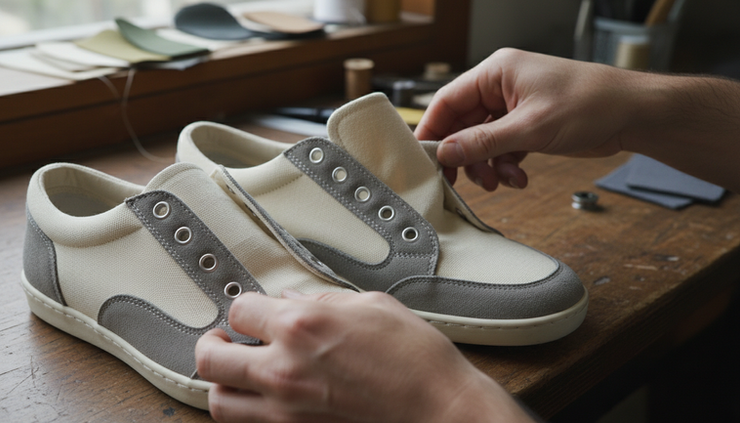
OEM stands for Original Equipment Manufacturer. In footwear, OEM means the manufacturer produces shoes according to the buyer’s specifications.
This is the key point: OEM follows buyer specifications.
The buyer may provide:
Product drawings or tech packs
Material specifications
Sole design
Last shape requirements
Construction details
Branding placement
Colour standards
Packaging requirements
Quality benchmarks
An OEM footwear manufacturer does not usually decide the full design independently. The brand brings the product concept and technical direction. The factory turns that concept into a manufacturable product.
This model is common when a brand wants control over the product. For example, a running-inspired sneaker brand may want a specific outsole pattern, upper panel design, cushioning feel, and material mix. An OEM partner can work from those specifications and produce the shoe under the brand’s name.
For founders searching for an OEM footwear manufacturer India, this model is useful when product identity matters. It supports custom footwear manufacturing India for brands that already know what they want to build.
The advantages of OEM include:
Higher design control
Stronger product differentiation
More control over materials and construction
Better fit for long-term brand building
Scope to create exclusive products
The challenges are also real. OEM usually needs more product development time, clearer documentation, more sampling, and stronger decision-making from the buyer. If the brief is unclear, the output can suffer.
What is ODM footwear manufacturing?
ODM stands for Original Design Manufacturer. In footwear, ODM means the manufacturer has its own pre-developed shoe designs, which a brand can customise and sell under its own label.
This is the key point: ODM uses pre-developed designs.
An ODM footwear manufacturer may already have sample ranges, tested constructions, existing sole moulds, material options, and style libraries. The brand selects a design and adapts it for its audience.
The customisation may include:
Upper material
Colour combination
Logo placement
Insole branding
Packaging
Minor design adjustments
Range planning across sizes and styles
ODM is useful for brands that want more flexibility than white label, but do not want to create every detail from scratch like OEM.
For example, a new lifestyle sneaker brand may choose an existing cupsole design from the manufacturer, change the upper material to vegan leather, use its own colour palette, and add branded insocks and boxes. That is closer to ODM than pure white label.
For brands looking for an ODM footwear manufacturer India, this model can reduce development time while still giving room to create a distinct product line.

What is the difference between OEM and ODM in footwear?
The main difference in OEM vs ODM footwear is who owns and leads the design direction.
In OEM, the buyer brings the specifications. The manufacturer makes the footwear as per those specifications.
In ODM, the manufacturer already has developed designs. The buyer chooses and customises one of those designs.
Here is a simple way to remember the OEM ODM footwear meaning:
OEM The brand says, “Make this footwear according to my design and specifications.”
ODM The manufacturer says, “Here are designs we have developed. You can customise and sell them under your brand.”
Both models can produce high-quality footwear. The right choice depends on how much control, time, and technical input the brand has.
Factor | Private Label | White Label | OEM | ODM |
Design | Usually based on manufacturer’s existing styles | Ready-made or near-ready designs | Created or specified by the buyer | Pre-developed by the manufacturer |
Customisation | Moderate, depending on the manufacturer | Low to limited | High | Moderate to high |
Branding | Sold under the buyer’s brand | Sold under the buyer’s brand | Sold under the buyer’s brand | Sold under the buyer’s brand |
Development | Some sampling and selection needed | Minimal development | Detailed development and sampling | Faster than OEM, more involved than white label |
Flexibility | Medium | Low | High | Medium to high |
Ideal customer | New and growing brands that want branded products with reasonable customisation | Sellers that want quick launch and simple products | Brands with clear designs, tech packs, or specific product needs | Brands that want ready design direction with brand-level changes |
This table is a guide, not a universal rule. Each manufacturer may define these footwear manufacturing models differently.
What is the difference between private label and OEM?
The difference between private label and OEM mainly comes down to product control and starting point.
Private label usually starts with the manufacturer’s existing product base. The brand customises it and sells it under its own name.
OEM starts with the buyer’s requirements. The manufacturer builds according to those requirements.
For example, suppose a brand wants to launch men’s casual loafers.
In a private-label model, the manufacturer may show existing loafer samples. The brand chooses a design, changes the colour, adds its logo, selects packaging, and places an order.
In an OEM model, the brand may provide a sketch, a specific toe shape, sole construction, upper material, lining requirement, and comfort standard. The manufacturer then develops samples to match that brief.
Private label is often better for speed and simplicity. OEM is better for originality and control.
A private label shoes manufacturer may also offer OEM services, but the process, timeline, pricing, and sampling requirements can change.
Which model is best for a new footwear brand?
There is no single best model for every new brand. The right choice depends on stage, budget, product clarity, and launch goals.
For many new shoe-brand founders in India, the practical path looks like this:
Choose white label if speed is the priority
White label can work when the goal is to test a product category quickly. It is suitable for basic styles where deep customisation is not needed.
Good fit for:
Marketplace sellers
Trend-testing collections
Simple product launches
Low-complexity footwear categories
Choose private label if you want a branded range without full development
Private label is often a strong starting point for D2C brands. It gives enough room for brand expression without the full demands of OEM.
Good fit for:
First footwear collections
E-commerce brands
Lifestyle labels
Founders testing product-market fit
Choose ODM if you want design options with customisation
ODM works well when you want a manufacturer’s design support. It gives a ready starting point while allowing changes that make the product feel more aligned with your brand.
Good fit for:
Brands without in-house shoe designers
Startups that want faster development
Growing brands expanding categories
Labels looking for tested constructions
Choose OEM if you have a clear product idea
OEM is best when the product must match your own design, performance, fit, or construction requirements.
Good fit for:
Brands with tech packs
Premium or niche footwear labels
Product-led startups
Growing brands creating exclusive collections
If this is your first footwear launch, avoid choosing a model only because it sounds more advanced. A well-executed private-label footwear India project can be more successful than a poorly planned OEM project.
Can one manufacturer offer multiple models?
Yes, one manufacturer can offer private label, white label, OEM, and ODM services. Many footwear factories support more than one model because brands come with different needs.
MakeMyShoe, for example, works as an Indian OEM, ODM, and private-label footwear manufacturer supporting startups and growing brands. A founder may begin with private label footwear, later move to ODM for adapted designs, and then develop OEM styles once the brand has clearer customer feedback.
This flexibility helps brands grow in stages. It also reduces the need to keep changing manufacturing partners as the business matures.
A good manufacturer should help you understand:
Which model suits your current stage
What level of customisation is realistic
Whether the design can be exclusive
What sampling steps are required
Which materials and constructions fit the product
How branding can be applied
What production limitations to expect
For a wider view of categories and founder types served, see the internal guide: Who We Serve — Overview.

What should you ask before choosing a footwear manufacturing model?
Before you compare quotes, ask practical questions. The answers will help you avoid confusion later.
Who owns the design after development?
Is the style exclusive to my brand?
What parts can be customised?
Can I change the sole, last, or upper pattern?
What logo placements are possible?
What materials are available?
How many rounds of sampling are expected?
What packaging options are supported?
Can the manufacturer scale if the product works?
Is this private label, white label, OEM, or ODM according to the manufacturer’s definition?
This last question matters because terminology is not always standard. One factory’s private label may look like another factory’s ODM. One supplier’s white label may mean ready stock, while another may allow small changes.
Clear communication is more useful than industry jargon.
FAQ
What does OEM mean in footwear?
OEM means the footwear manufacturer makes shoes according to the buyer’s design, specifications, materials, and quality requirements.
What does ODM mean in footwear?
ODM means the manufacturer provides pre-developed footwear designs that a brand can customise and sell under its own name.
Is private label the same as white label footwear?
Not always. White label usually means ready products with minimal changes, while private label often allows more branding and customisation. Definitions can vary by manufacturer.
Which is better for a new shoe brand, OEM or ODM?
ODM is usually easier for new brands without detailed designs. OEM is better when the brand already has clear specifications or wants a highly custom product.
Can I sell OEM footwear under my own brand?
Yes. OEM footwear is manufactured for your brand based on your requirements and sold under your brand name.
Does private label footwear allow custom branding?
Yes. Private label footwear usually allows branding on areas such as insoles, tongues, outsoles, boxes, labels, and packaging, depending on the manufacturer.
Is OEM footwear manufacturing more flexible than private label?
Yes, OEM usually offers more flexibility because the product is built around the buyer’s specifications. It may also need more time and development work.
Can MakeMyShoe support startups in India?
Yes. MakeMyShoe supports footwear startups and growing brands in India through OEM, ODM, and private-label manufacturing models.
Final takeaway for new footwear brands
The simplest way to compare private label vs OEM vs ODM footwear is to look at where the design starts.
White label starts with a ready product. Private label starts with an existing product base and adds brand-level customisation. ODM starts with the manufacturer’s developed design and allows adaptation. OEM starts with the buyer’s specification and gives the highest control.
For a new brand, the right choice is the one that matches your product clarity, budget, timeline, and need for differentiation. Start with the model you can execute well. Then build deeper customisation as your brand gains customer feedback.
If you are planning a footwear line and want help choosing the right route, contact MakeMyShoe to discuss OEM, ODM, and private-label footwear manufacturing.


